



Architecture
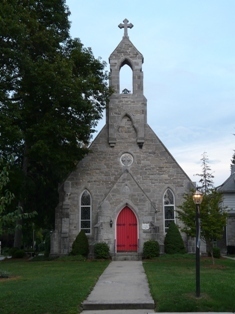
"St. James is an excellent example of outstanding architecture in a small structure....the proportion and design elements came together in one of the finest examples of Gothic Revival charm. St. James is a Richard Upjohn design. Upjohn was born in England in 1802 and moved to the US in 1829. This founder and first president of the American Institute of Architects was largely responsible for the introduction of Gothic Revival architecture to the US and helped to define American church architecture. His most famous design is Trinity Church in New York City."
"Upjohn considered himself to be an Episcopalian first and an architect second, often asking little or no compensation for his designs. He acted from a sincere desire to improve the conditions of rural churchgoing. the flowering of the Episcopal Church in America from 1840 through the 1860s led to numerous and widespread commissions for churches and these churches (along with those illustrated in his 1852 building plans book, Rural Architecture) served as patterns for countless buildings throughout the country.
The pointed arches are the most obvious indicator of Gothic style, as are the buttresses at each corner and along the sides. These stone projections weren't just ornamental. Each buttress prevents the stone walls from falling outward and these structural supports have become a strong visual element of Gothic architecture. Atop the church is not a bell tower or belfry, but a bellcote. A bellcote is smaller than a bell tower."
{Source: Learning Architecture by The Bedford County Educational Series}
Overlooking the small Memorial Garden is the most famous window in the church: A Tiffany. Visitors are always welcome to visit St. James. Personal tours may be arranged by calling the parish.